
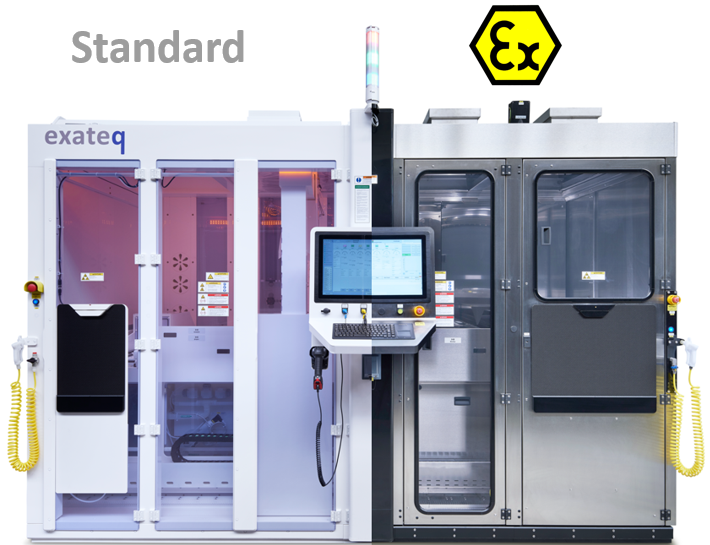
Standard and stainless-steel wet bench designs: different material concepts for different requirements.
Standard plastics in wet bench construction
Wet bench housings, also called base bodies or base modules, are often made from plastics resistant to acids and alkalis. White or natural polypropylene (PP) and polyvinyl chloride (PVC) are commonly used. For many applications, these plastics offer good chemical resistance, sufficient mechanical strength and good value. Suitability depends on the chemicals, temperatures and mechanical loads involved.
FM 4910: additional fire protection requirements
FM 4910-recognized plastics are used particularly in semiconductor fabrication plants when corrosive chemicals are combined with demanding fire protection requirements. The FM 4910 standard evaluates the fire behaviour of suitable plastics for cleanroom applications, including smoke generation and flame spread. These specialist plastics cost considerably more than conventional housing materials. Recognition of a material under FM 4910 does not constitute approval of the complete wet bench.
ATEX: stainless steel or conductive plastic?
Where explosive atmospheres may occur, applicable explosion protection requirements must be considered during system design. An ignition hazard assessment may show that housings or individual components must safely dissipate electrostatic charge. Suitable metals and dissipative or conductive plastics are the main options. These material groups differ in their properties, processing and assembly.
Stainless steel is widely used in industry. Its availability and established fabrication methods make it suitable for many wet benches with explosion protection requirements. When demanding fire protection requirements also apply, stainless steel can be a particularly natural choice. It is not essential in every case: the decisive factors are the operator’s specific requirements, chemical exposure and the overall protection concept.
A plastic is not ATEX-compliant simply because it is described as conductive. Surface and dissipation resistance, earthing, possible charging mechanisms and the intended hazardous zone must be assessed for the actual design.
What advantages do conductive plastics offer?
If a potentially explosive atmosphere is combined with a highly corrosive environment, such as warm hydrochloric acid, some stainless steels can reach their limits and corrode. This compromises long-term reliability. Suitable conductive plastics may be a better option. This must be assessed using concentration, temperature, loading and material data.
There are further potential advantages. The design of housings and structural components can often use similar basic concepts for standard plastics and appropriately modified conductive plastics. The required wall thicknesses and strengths must nevertheless be checked for each design.
This affects engineering effort. Companies using platform-based designs rather than developing every system from scratch can draw on proven modules and design data. Switching between standard plastics and suitable conductive variants can therefore often be achieved without substantial additional engineering costs. Established manufacturing methods, assembly experience and supply chains for plastic wet benches offer further benefits.
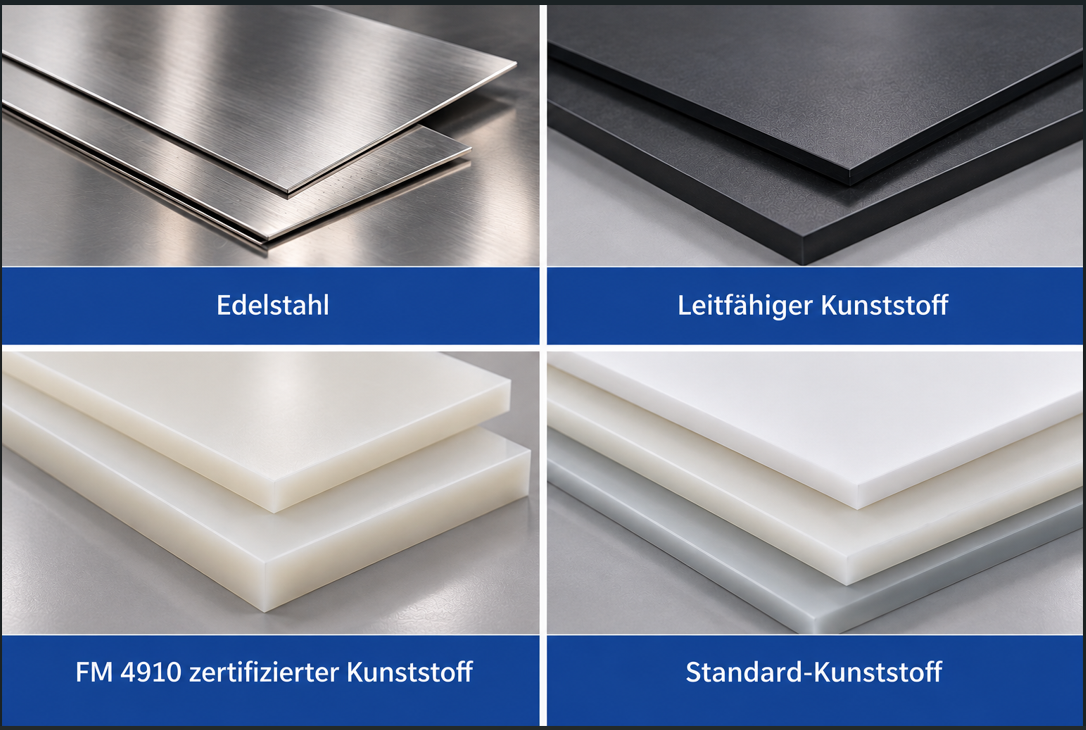
Four typical material groups compared: stainless steel, conductive plastic, FM 4910-recognized plastic and standard plastic.
Materials compared directly
| Material | Chemical suitability | Electrostatics | Fire protection / cost |
|---|---|---|---|
| PP / PVC | Depends on chemicals and temperature | Not inherently dissipative | Standard solution, often economical |
| PP-EL / PE-EL | Depends on chemicals and temperature | Dissipative | Explosion protection concept possible; check suitability |
| FM 4910 plastic | Depends on material type | Not automatically dissipative | For demanding cleanroom fire protection requirements; higher cost |
| Stainless steel | Depends on alloy and chemicals | Dissipative when suitably bonded | Non-combustible material; depends on corrosion exposure |
Note: this table provides initial guidance. It does not replace chemical resistance testing or system-specific fire and explosion protection assessments.
Selecting the housing material in practice
The following decision guide illustrates a simplified preliminary selection. A final decision must also consider chemical resistance, hazardous area classification, electrostatic properties and the fire protection requirements that actually apply.
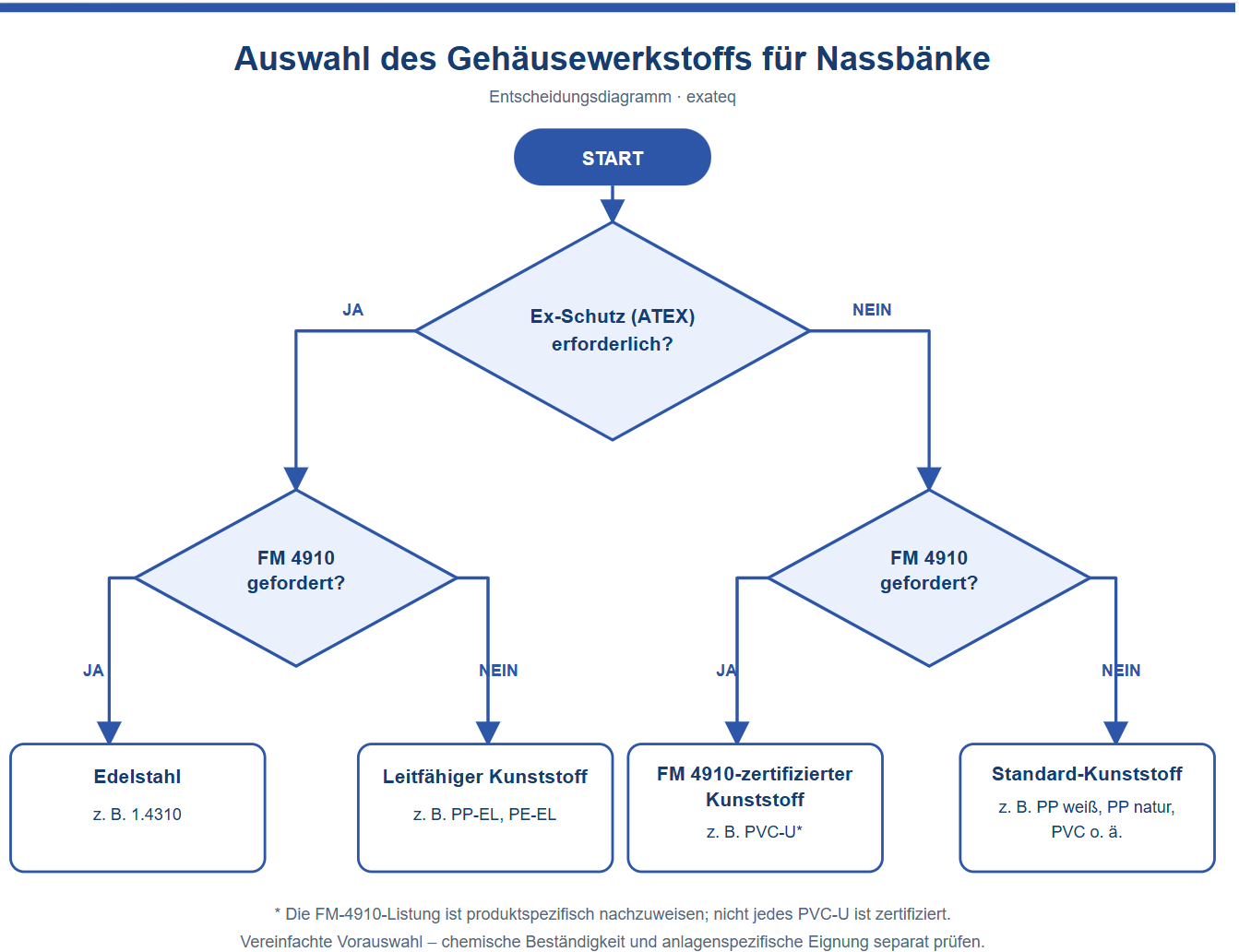
Simplified engineering decision guide; not blanket ATEX or FM 4910 approval.
Frequently asked questions about material selection
Which plastics are suitable for ATEX wet benches?
Depending on the application, suitable conductive or dissipative variants of PP or PE may be considered. Suitability must be demonstrated within the specific explosion protection concept.
Is stainless steel mandatory for explosion-protected wet benches?
No, not as a general rule. Stainless steel can be a sensible solution, but suitable conductive plastics may also be used provided all requirements are met.
Is FM 4910-recognized plastic automatically suitable for ATEX applications?
No. FM 4910 concerns the fire behaviour of the material. Electrostatic properties and explosion protection must be assessed separately.
Why can plastic be more economical?
In platform-based wet bench designs, existing plastic designs and manufacturing processes can often be adapted to different material variants.
An engineering perspective
Stainless steel is a proven material, but it is not automatically the best choice for every wet bench with ATEX requirements. Suitable conductive plastics can offer technical and economic advantages, particularly with corrosive chemicals. The material name alone is not decisive: chemical resistance, explosion protection, fire protection and structural design must work together. This is why material selection deserves attention from the start of system design.

Florian Süß
Project management & sales | exateq GmbH
Florian Süß has many years of experience in project management and the design of wet chemical equipment. Since exateq was founded in 2015, he has contributed his expertise to practical, customer-specific solutions for high-tech industries.
More articles by this author ↗