
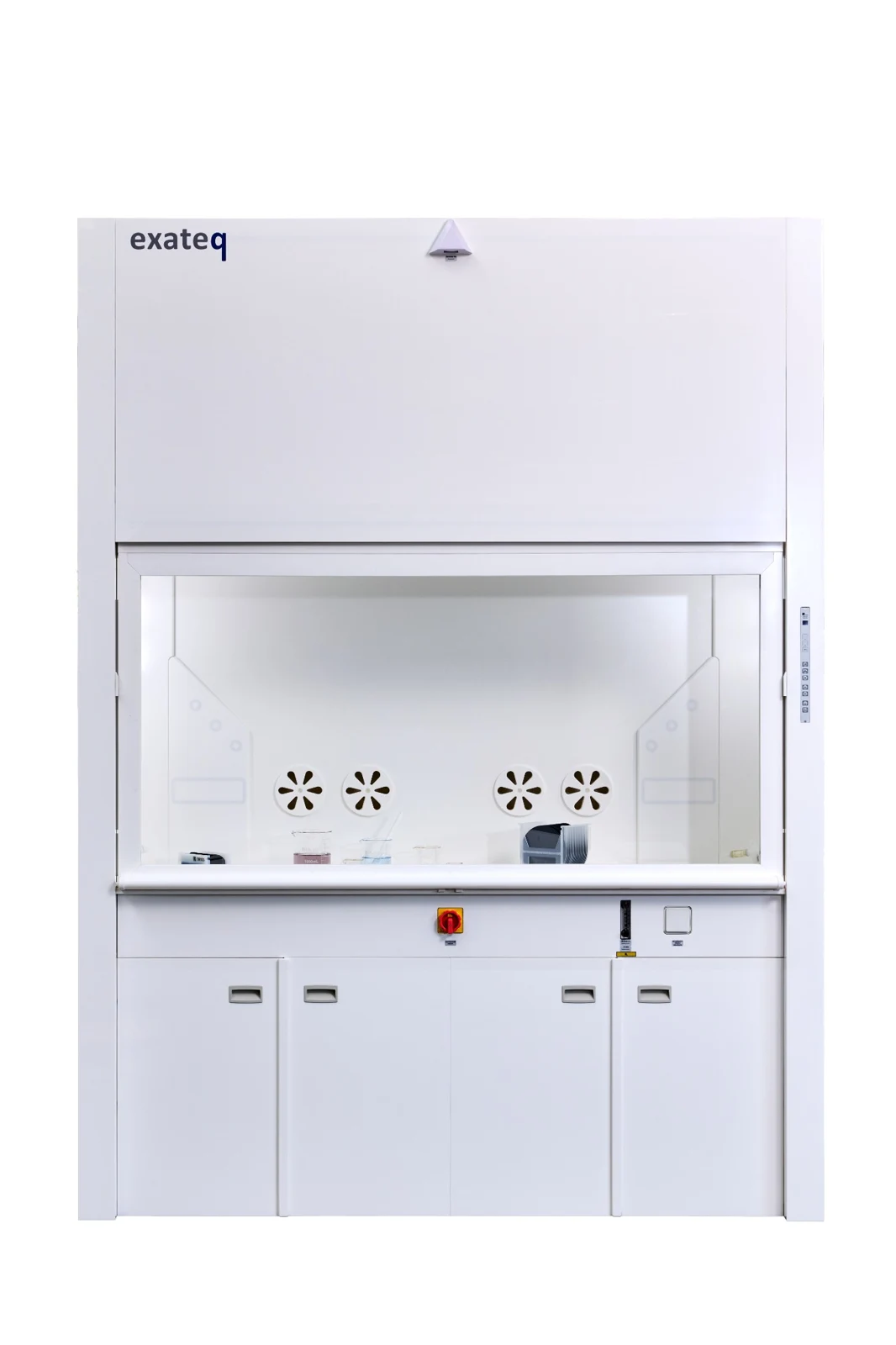
Cover image: The exateq fume hood qCFS (digestorium) in a completed configuration.
Two Customer Inquiries as the Starting Point for the Fume Hood
Fume hoods (digestoria) – commonly referred to as laboratory hoods or chemical hoods – capture vapors and gases at the workstation and exhaust or treat them. The development of our qCFS (Clean Flow System) fume hood began with two inquiries from existing customers received within a few months of each other. One of the customers is a major chemical corporation, the other operates in the semiconductor industry. Both companies were familiar with our work from previous projects and trusted our expertise in the engineering and manufacturing of wet-chemical systems.
Although both customers required a fume hood, their technical specifications differed significantly in some areas, particularly regarding airflow management and filtration technology. This sparked the idea not only to build two customized systems, but to establish a shared foundation for future projects.
From the very beginning, operator safety was a paramount consideration. When handling chemicals, potentially hazardous vapors and gases must be reliably captured, extracted, or treated according to the specific requirements of the application.
Self-Supporting Fume Hood Made of Polypropylene
First, we analyzed the customer requirements and derived an engineering concept. We chose a self-supporting plastic fume hood made of polypropylene (PP). This material is resistant to many media used in wet chemistry and can be fabricated into complex assemblies using plastic welding processes. Whether it is suitable for an application must always be evaluated based on the specific chemicals and operating conditions.
We were able to draw extensively on our experience in plastics engineering. The self-supporting design eliminates the need for an additional load-bearing metal frame. At the same time, stability, assembly layout, and manufacturing considerations had to be incorporated right from the design phase.
The base cabinet was also designed for flexible utilization: In addition to drip trays and media connections, it can accommodate pumps, valves, and additional laboratory or process equipment. Even though the hoods are predominantly custom-built, a shared base design forms the foundation for diverse configurations.
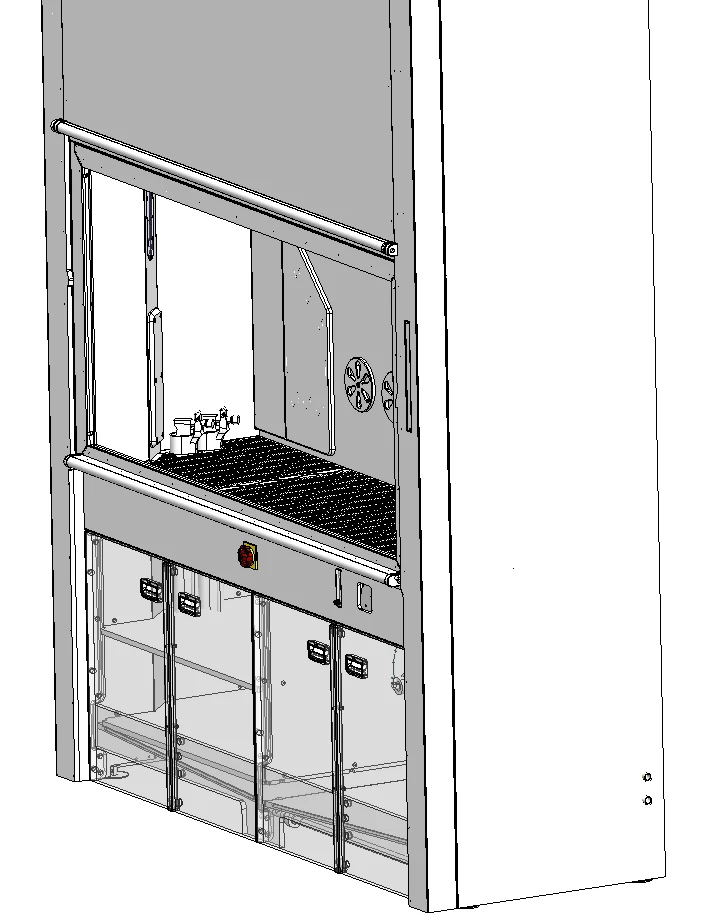
CAD view of the fume hood: work area, vertically moving sash, and integrated base cabinet.
Airflow in the Fume Hood: Diverse Concepts as an Engineering Challenge
The greatest technical challenge was the integration of different airflow concepts. Even the first two customer projects placed markedly different demands on ventilation technology.
Depending on the application, the fume hood can be equipped with passive supply air from the laboratory room or with active supply air via fans. For applications with elevated particle purity requirements, a variant with HEPA-filtered supply air was also planned. Another option is a filtered recirculation mode with application-specifically selected filter stages.
HEPA filters separate particulate matter, but not gaseous pollutants. For acidic, basic, or organic gases, suitable filter media tailored to the respective substances are required. In particular, the suitability of a recirculation concept must be evaluated separately for the specific chemicals and operating conditions.
The main ventilation assemblies are largely arranged above the workspace; the filter units are also integrated directly into the fume hood. Space for fans, filters, and air ducts, as well as installation and maintenance access, had to be factored into the basic design from the outset, while minimizing any restriction of the usable workspace.
Sash Mechanics and Airflow Control
The vertically moving sash (front pane) can be operated manually or electrically depending on the version. For the manual version, smooth and effortless operation was the priority. The automatic version opens and closes motorized, either via pushbuttons or touch/jog mode directly on the pane.
A particular challenge was the compact integration of the mechanical system into the plastic construction. In addition to the sash guidance, the automatic version also had to accommodate the electric drive, position sensing, and obstacle detection.
The detected sash position can be utilized to adjust the air volume flow to the respective operating state. Airflow is monitored via differential pressure measurement; visual and acoustic alarms are triggered if values deviate from defined operating limits. For suitable operating conditions, a setback mode was also incorporated: this reduces the air volume flow whenever the fume hood is not in use.
Operation is designed around a combination of pushbuttons and a display. Frequently used functions remain directly accessible, while additional operating information can be shown on the display.
Custom Equipment for Laboratory Applications
Another focus was the adaptability of the work area. Depending on customer requirements, basins can be integrated directly into the work surface or provided as a tabletop basin version. Additional options include drainage funnels, electrical outlets, vacuum ports, and spray guns for deionized water (DI water) and nitrogen.
The variety of these equipment options directly impacts engineering design. Work surfaces, media connections, routing pathways, and component accessibility must be carefully coordinated. The objective was therefore not an overly extensive standard package, but rather a base design that supports diverse workflows.
From Engineering to the First Customer Systems
We dispensed with a separate prototype. The first fume hoods were built directly as customer systems. Consequently, the design solutions had to not only function reliably from the outset, but also be reliably manufacturable and assembleable.
Because we completed most of the manufacturing in-house, we could draw on established expertise in plastics processing and wet-chemical system construction. Particular attention was paid to the sash mechanics as well as ease of assembly and component accessibility.
Prior to delivery, we tested sash movement, differential pressure measurement, airflow, and visual and acoustic warning systems in-house. Subsequently, on-site trials were conducted at customer facilities to evaluate the systems under real-world operating conditions.
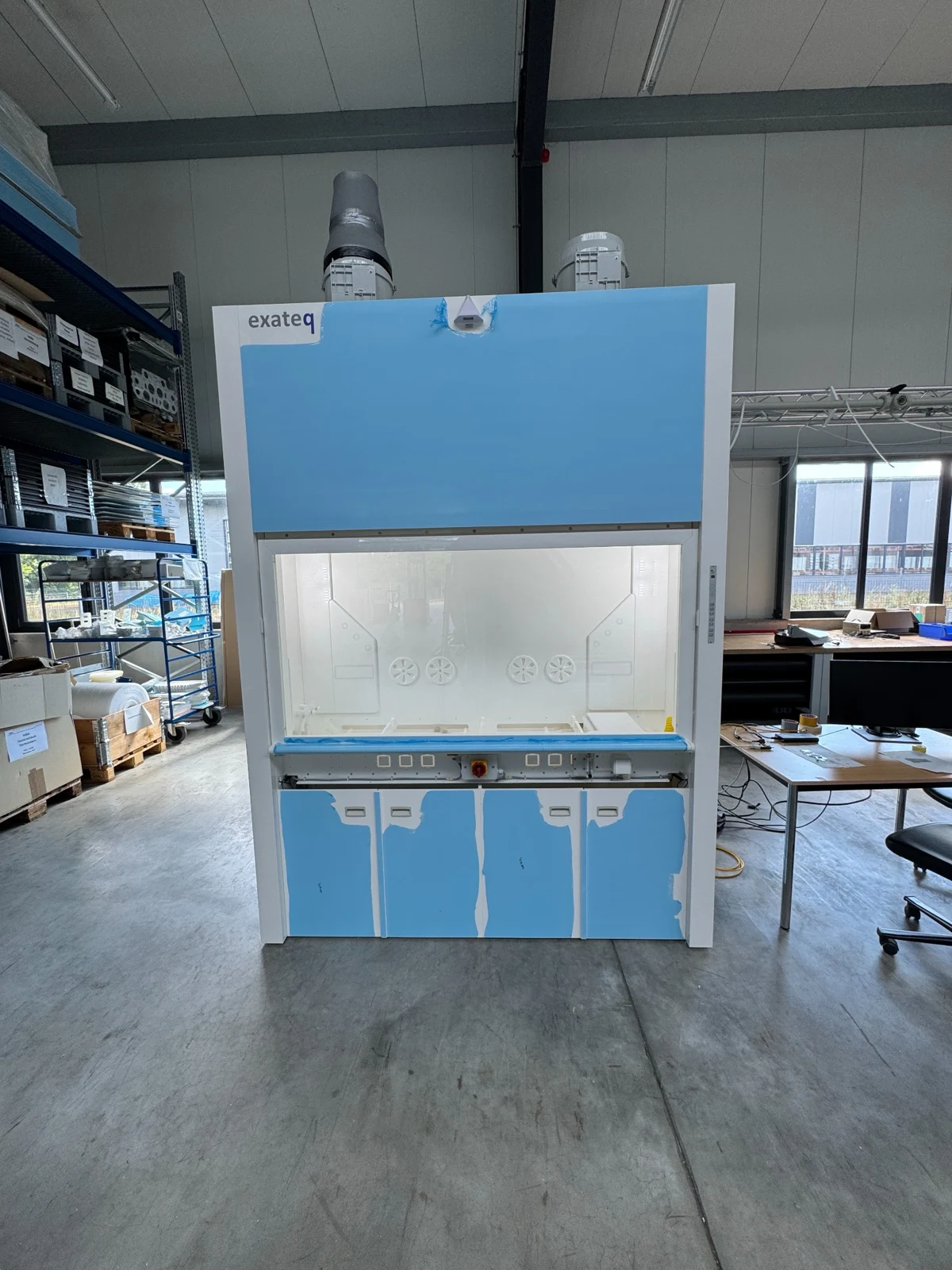
The qCFS fume hood during construction and commissioning at exateq – still featuring protective films and visible ventilation components.
From Customer Project to an Independent Product Family
The insights gained from the first two customer projects laid the foundation for further developing our fume hood. Today, the qCFS is an integral part of our product portfolio. The overwhelmingly positive feedback from our initial customers affirmed our decision to continue along this path.
Customized execution will remain key in the future. At the same time, we aim to further standardize the shared platform to implement diverse requirements even more efficiently. Additional sizes and dimensions as well as expanded airflow and filtration concepts are planned.
Furthermore, we are working on future configurations for potentially explosive atmospheres (explosion protection / ATEX). These impose additional requirements on design, components, and safety concepts, requiring dedicated development and assessment for each specific application.
From two initially independent customer inquiries, an independent product family has emerged. This development demonstrates how our expertise in plastics engineering and wet-chemical system construction can be successfully transferred to new applications.
Patrick Könlein
Mechanical design technician
Patrick Könlein joined exateq in 2021. He designs assemblies for wet chemical equipment, with a focus on substrate handling systems, standalone units and process tanks.
More articles by this author ↗